Gain calibration demo on simulated data
This notebook demonstrates gain calibration with ASKAPsoft. We create a simulated data with some corruption and then solve for the gains with ccalibrator and image the data after applying the gain solution
Tools used in this notebook 1. askapsoft * cmodel * csimulator * mslist * imager * ccalibrator 3. bptool 4. python-casacore
[1]:
source_name = 'PKS 1934-638'
source_ms = 'PKS1934-638'
ms_filename = f'{source_ms}.ms'
model_name = f'{source_ms}.model'


nchan = 48
frequency="887MHz"
increment="1MHz"
[2]:
# Clean up
import os

os.system(f"rm *.log *.i{source_ms}.fits")
os.system(f"rm -rf {ms_filename} {model_name}")
rm: *.iPKS1934-638.fits: No such file or directory
[2]:
0
[51]:
# A function to plot FITS
import matplotlib.pyplot as plt
import matplotlib.colors as mcolors
from astropy.io import fits
from astropy.wcs import WCS
import numpy as np
from casacore.images import image
import matplotlib.patches as patches

%matplotlib inline

def plot_image(file, color_norm=None, norm=None, color_bar=False, box=None, print_stats=False):
    # Using one of the files to setup WCS projection
    hdu = fits.open(file)[0]

    wcs = WCS(hdu.header, naxis=2)
    fig, ax = plt.subplots(1, 1, figsize=(6, 6), subplot_kw=dict(projection=wcs))

    print(fits.info(file))
    hdu = fits.open(file)[0]

    if color_norm:
        im = ax.imshow(hdu.data[0,0,:,:], origin='lower', cmap='viridis', norm=mcolors.PowerNorm(color_norm))
    elif norm:
        sigma = np.std(hdu.data[0,0,:,:])
        mean = np.std(hdu.data[0,0,:,:])
        im = ax.imshow(hdu.data[0,0,:,:], origin='lower', cmap='viridis', vmin=-norm*sigma, vmax=norm*sigma)
    else:
        im = ax.imshow(hdu.data[0,0,:,:], origin='lower', cmap='viridis')

    if print_stats:
        if box:
            stats = image(file).subimage(
                    (0, 0, box["f0"] - box["width"] // 2, box["f1"] - box["height"] // 2),
                    (0, 0, box["f0"] + box["width"] // 2, box["f1"] + box["height"] // 2)
                ).statistics()
        else:
            stats = image(file).statistics()
        print("------------------------------------------")
        print("------------ Mean and RMS region ---------")
        print("------------------------------------------")
        print(f"MEAN: {stats["mean"]}")
        print(f"RMS: {stats["rms"]}")
        print("------------------------------------------")


    if box:
        ax.add_patch(
            patches.Rectangle(
                xy=(box["f0"], box["f1"]),  # point of origin.
                width=box["width"], height=box["height"], linewidth=1,
                color='red', fill=False))

    ax.set_xlabel('RA')
    ax.set_ylabel('Dec')
    ax.set_autoscale_on(False)
    ax.set_title(file)
    plt.colorbar(im, ax=ax)

    plt.show()
[4]:
from astropy.coordinates import SkyCoord

# Get the coordinates from Sesame
coord = SkyCoord.from_name(source_name)

ra ,dec = coord.to_string('hmsdms').split(" ")

# If you are offline, uncomment this
# ra ,dec = "08h16m36.24s -70d39m55.08s"

print(ra, dec)

direction=f"[{ra}, {dec}, J2000]"
19h39m25.0245312s -63d42m45.640368s
[5]:
from taitale import taitale_env

env = taitale_env(
    image = "csirocass/askapsoft",
    tag = "1.17.6-openmpi4",
)
[6]:
from taitale.askap import cmodel

votablename = "AS110/RACS1951-62A/image.i.SB8676.cont.RACS_1951-62A.linmos.taylor.0.restored.cres.fcor.components.xml"

cmodel(
    env=env,
    workers=3,
    args={
        "gsm.database": "votable",
        "gsm.file": votablename,
        "gsm.ref_freq": frequency,
        "primarybeam": "GaussianPB",
        "bunit": "Jy/pixel",
        "frequency": frequency,
        "increment": increment,
        "flux_limit": "10uJy",
        "shape": [2048, 2048],
        "cellsize": ['2.5arcsec','2.5arcsec'],
        "direction": direction,
        "nterms": 1,
        "stokes": "[I]",
        "output": "casa",
        "filename": model_name,
    }
)
Starting cmodel
Debug: registered context Global=0
Debug: registered context Global=0
Debug: registered context Global=0
cmodel complete
Simulating the MS with some corruption
Creating a gain corruption table
[7]:
import numpy as np
nantennas = 36

def get_noisy_flux(gain = 1 + 0j, noise_level = 0.1):
    magnitude = np.abs(gain)
    noise_std = 0.1 * magnitude

    noisy_real = np.random.normal(np.real(gain), noise_std)
    noisy_imag = np.random.normal(np.imag(gain), noise_std)
    return noisy_real, noisy_imag

gain_corruption_file = "gains.core.true"

with open(gain_corruption_file, "w+") as f:
    for antenna_idx in range(nantennas):
        g11 = get_noisy_flux()
        g22 = get_noisy_flux()

        # d12 = get_noisy_flux()
        # d21 = get_noisy_flux()

        f.write(f"gain.g11.{antenna_idx}.0 = [{g11[0]}, {g11[1]}]\n")
        f.write(f"gain.g22.{antenna_idx}.0 = [{g22[0]}, {g22[1]}]\n")
Simulating data with gain corruption
[8]:
from taitale.askap import csimulator
import os

os.system(f"rm -rf {ms_filename}")

csimulator(
    env=env,
    parset="./parsets/csimulator.in",
    args={
        "dataset": ms_filename,
        "sources.names": f"[{source_name}]",
        f"sources.{source_name}.direction": direction,
        f"sources.{source_name}.model": model_name,
        "spws.names": "[TestBand]",
        "spws.TestBand": f'[48, {frequency}, 1.0MHz, "XX XY YX YY"]',
        "observe.number": 1,
        "observe.scan0": f"[{source_name}, TestBand, -2h, 2h]",

        "noise": "false",
        "noise.rms": 1,

        "corrupt": "true",
        "calibaccess": "parset",
        "calibaccess.parset": "gains.core.true"
    },
)
Starting csimulator
Debug: registered context Global=0
csimulator complete
[9]:
from taitale.askap import mslist

mslist(env=env, args=f"--full {ms_filename}", logfile="mslist.txt")
Starting mslist
mslist complete
[10]:
!cat mslist.txt
Debug: registered context Global=0
2025-04-11 06:52:20     INFO               Observer: ASKAP simulator     Project:
2025-04-11 06:52:20     INFO    +       Observation: ASKAP36(36 antennas)
2025-04-11 06:52:20     INFO    MSMetaData::_computeScanAndSubScanProperties    Computing scan and subscan properties...
2025-04-11 06:52:20     INFO            Data records: 60480       Total elapsed time = 14400 seconds
2025-04-11 06:52:20     INFO    +          Observed from   06-Mar-2007/22:56:44.6   to   07-Mar-2007/02:56:44.6 (UTC)
2025-04-11 06:52:20     INFO
2025-04-11 06:52:20     INFO            Fields: 1
2025-04-11 06:52:20     INFO    +         ID   Code Name                            RA               Decl           Epoch        nRows
2025-04-11 06:52:20     INFO    +         0         PKS 1934-638                    19:39:25.024531 -63.42.45.64037 J2000        60480
2025-04-11 06:52:20     INFO            Spectral Windows:  (1 unique spectral windows and 1 unique polarization setups)
2025-04-11 06:52:20     INFO    +         SpwID  Name     #Chans   Frame   Ch0(MHz)  ChanWid(kHz)  TotBW(kHz) CtrFreq(MHz)  Corrs
2025-04-11 06:52:20     INFO    +         0      TestBand     48   TOPO     887.000      1000.000     48000.0    910.5000   XX  XY  YX  YY
2025-04-11 06:52:20     INFO            The SOURCE table is absent: see the FIELD table
2025-04-11 06:52:20     INFO    +       Antennas: 36 'name'='station'
2025-04-11 06:52:20     INFO    +          ID=   0-4: 'Pad01'='', 'Pad02'='', 'Pad03'='', 'Pad04'='', 'Pad05'='',
2025-04-11 06:52:20     INFO    +          ID=   5-9: 'Pad06'='', 'Pad07'='', 'Pad08'='', 'Pad09'='', 'Pad10'='',
2025-04-11 06:52:20     INFO    +          ID= 10-14: 'Pad11'='', 'Pad12'='', 'Pad13'='', 'Pad14'='', 'Pad15'='',
2025-04-11 06:52:20     INFO    +          ID= 15-19: 'Pad16'='', 'Pad17'='', 'Pad18'='', 'Pad19'='', 'Pad20'='',
2025-04-11 06:52:20     INFO    +          ID= 20-24: 'Pad21'='', 'Pad22'='', 'Pad23'='', 'Pad24'='', 'Pad25'='',
2025-04-11 06:52:20     INFO    +          ID= 25-29: 'Pad26'='', 'Pad27'='', 'Pad28'='', 'Pad29'='', 'Pad30'='',
2025-04-11 06:52:20     INFO    +          ID= 30-34: 'Pad31'='', 'Pad32'='', 'Pad33'='', 'Pad34'='', 'Pad35'='',
2025-04-11 06:52:20     INFO    +          ID= 35-35: 'Pad36'=''
2025-04-11 06:52:20     INFO            The HISTORY table is empty
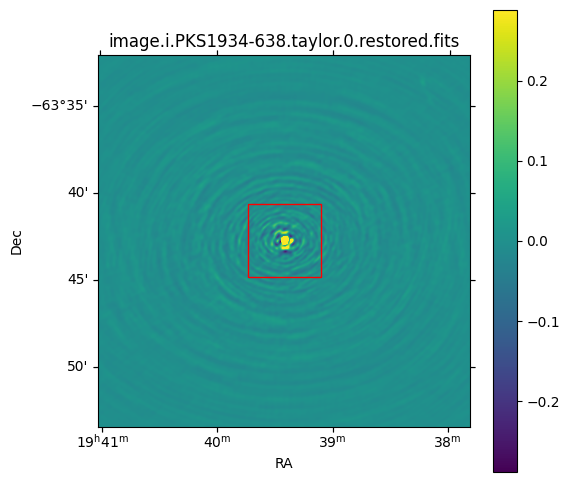
Imaging without calibration
[11]:
from taitale.askap import imager

image_name = f"image.i.{source_ms}"
imaging_workers = 1
nchanpercore = nchan // imaging_workers

print(f"channels: {nchan}")
print(f"nchanpercore: {nchanpercore}")
print(f"mpi_workers: {imaging_workers}")

# Default parset for Clean used
imager(
    env=env,
    workers=imaging_workers+1,
    parset="./parsets/cimager.in",
    args={
        "dataset": f"./{ms_filename}",
        "Images.Names": image_name,
        f"Images.{image_name}.direction": direction,
        f"Images.{image_name}.nchan": 1,
        f"Images.{image_name}.nterms": 2,
        "Images.shape": "[512, 512]",
        "Images.cellsize": "['2.5arcsec', '2.5arcsec']",
        "nchanpercore": nchanpercore,
        "restore": True,
    }
)
channels: 48
nchanpercore: 48
mpi_workers: 1
Starting imager
Debug: registered context Global=0
Debug: registered context Global=0
imager complete
[52]:
plot_image(image_name + ".taylor.0.restored.fits", norm=3, color_bar=True, box=dict(f0=206, f1=206, width=100, height=100), print_stats=True)
Filename: image.i.PKS1934-638.taylor.0.restored.fits
No.    Name      Ver    Type      Cards   Dimensions   Format
  0  PRIMARY       1 PrimaryHDU      64   (512, 512, 1, 1)   float32
None
------------------------------------------
------------ Mean and RMS region ---------
------------------------------------------
MEAN: [0.01395344]
RMS: [0.32471413]
------------------------------------------
2025-04-11 07:16:25 INFO FITSCoordinateUtil::fromFITSHeader Neither SPECSYS nor VELREF keyword given, spectral reference frame not defined ...
Calibration
As a simple demonstration we are going to use the model we used for simulation for the calibration. ccalibrator will solve the gains and create a gain table
[21]:
from taitale.askap import ccalibrator

ccalibrator(
    env=env,
    workers=2,
    args={
        "dataset": ms_filename,
        "refgain": "gain.g11.0.0",

        "sources.names": "[PKS1934638]",
        "sources.PKS1934638.direction": direction,
        "sources.PKS1934638.model": model_name,

        "gridder.snapshotimaging": "false",
        "gridder": "WProject",
        "gridder.WProject.wmax": 35000,
        "gridder.WProject.nwplanes": 257,
        "gridder.WProject.oversample": 7,
        "gridder.WProject.maxsupport": 512,
        "gridder.WProject.variablesupport": "true",
        "gridder.WProject.offsetsupport": "true",
        "gridder.WProject.sharecf": "true",
        "gridder.WProject.frequencydependent": "true",

        "ncycles": "5",
        "solver": "SVD",

        # "calibaccess": "parset",
        # "calibaccess.parset": "caldata.parset",

        "calibaccess": "table",
        "calibaccess.table": "caldata.tab",
        "calibaccess.table.maxant": 36,
        "calibaccess.table.maxbeam": 36,
        "calibaccess.table.maxchan": 48,
        "calibaccess.table.reuse": "false"
    }
)
Starting ccalibrator
Debug: registered context Global=0
Debug: registered context Global=0
ccalibrator complete
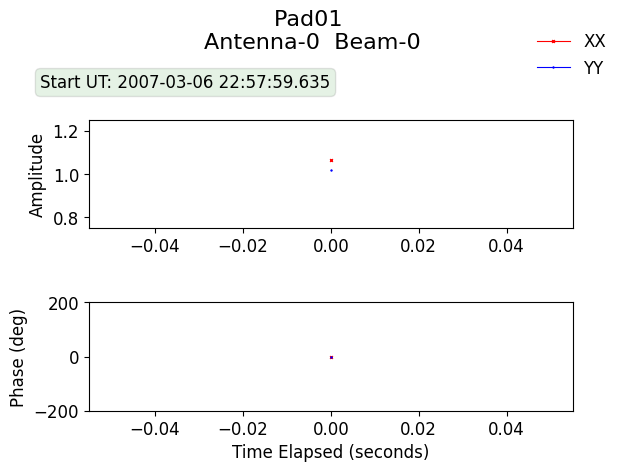
Viewing our calibration solution
[22]:
bptool_env = taitale_env(
    image = "wasimraja81/askappy-ubuntu",
    tag = "bptool-2.4",
)
[23]:
from taitale.utils import CliArgs
from taitale.utils.wrapper import cli_app

def plot_gains(**kwargs):
    cli_args = CliArgs()
    bptool_app = cli_app(
        name="plot_gains",
        cmd="plot_gains.py {option}",
        cli_args=cli_args,
    )

    bptool_app(**kwargs)
[24]:
plot_gains(env=bptool_env, args=f"-t caldata.tab -b1 0 -b2 0 -s -m {ms_filename}", logfile="bptool.txt")
Starting plot_gains
/usr/local/lib/python3.6/dist-packages/astropy/config/configuration.py:581: ConfigurationMissingWarning: Configuration defaults will be used due to PermissionError:13 on None
  warn(ConfigurationMissingWarning(msg))
Matplotlib created a temporary config/cache directory at /tmp/matplotlib-gqtmsnla because the default path (/.config/matplotlib) is not a writable directory; it is highly recommended to set the MPLCONFIGDIR environment variable to a writable directory, in particular to speed up the import of Matplotlib and to better support multiprocessing.
WARNING: CacheMissingWarning: Remote data cache could not be accessed due to PermissionError: [Errno 13] Permission denied: '/.astropy' [astropy.utils.data]
WARNING: CacheMissingWarning: Not clearing data cache - cache inaccessible due to PermissionError: [Errno 13] Permission denied: '/.astropy' [astropy.utils.data]
WARNING: CacheMissingWarning: ("Cache directory cannot be read or created ([Errno 13] Permission denied: '/.astropy'), providing data in temporary file instead.", '/tmp/astropy-download-1-ohxmqp3l') [astropy.utils.data]
/_build/bptool/bptool/bin/plot_gains.py:240: RuntimeWarning: invalid value encountered in double_scalars
  dT = (time_arr[nTime-1] - time_arr[0])/(nTime-1)
plot_gains complete
[25]:
!cat bptool.txt
Successful readonly open of default-locked table caldata.tab: 3 columns, 1 rows
Plotting gain solutions for Input table: caldata.tab
For:
            Beam Nums:  0 - 0
            Ante Nums:  0 - 0
          Ignore Beam:  False
[26]:
from IPython.display import Image
Image(filename='caldata.beam00.ante00.png')
[26]:
Applying the calibration solution
Finally we’ll use the calibration table for imaging
[27]:
image_name_cal = f"image.i.{source_ms}.cal"

imager(
    env=env,
    workers=imaging_workers+1,
    parset="./parsets/cimager.in",
    args={
        "dataset": f"./{ms_filename}",
        "Images.Names": image_name_cal,
        f"Images.{image_name_cal}.direction": direction,
        f"Images.{image_name_cal}.nchan": 1,
        f"Images.{image_name_cal}.nterms": 2,
        "Images.shape": "[512, 512]",
        "Images.cellsize": "['2.5arcsec', '2.5arcsec']",
        "nchanpercore": nchanpercore,
        "restore": True,

        # Calibrate with the generated gain table
        "calibrate": "true",
        "calibrate.ignorebeam": "true",
        "calibrate.allowflag": "true",
        "calibrate.scalenoise": "true",
        "calibrate.interpolatetime": "true",


        "calibaccess": "table",
        "calibaccess.table": "caldata.tab",
        "calibaccess.table.maxant": 36,
        "calibaccess.table.maxbeam": 36,
        "calibaccess.table.maxchan": 48,
        "calibaccess.table.reuse": "false"
    }
)
Starting imager
Debug: registered context Global=0
Debug: registered context Global=0
imager complete
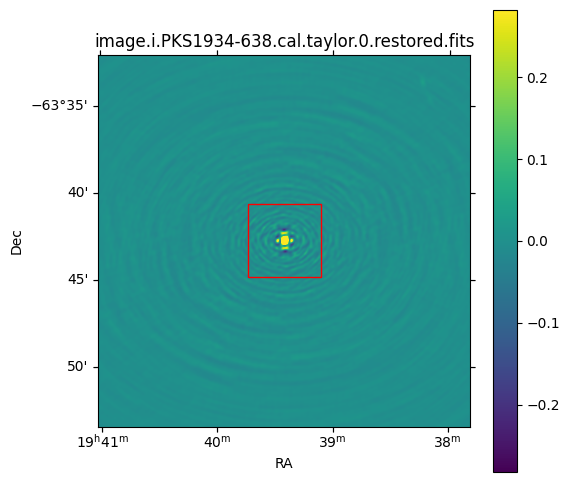
Image after calibration
[53]:
plot_image(image_name_cal + ".taylor.0.restored.fits", norm=3, color_bar=True, box=dict(f0=206, f1=206, width=100, height=100), print_stats=True)
Filename: image.i.PKS1934-638.cal.taylor.0.restored.fits
No.    Name      Ver    Type      Cards   Dimensions   Format
  0  PRIMARY       1 PrimaryHDU      64   (512, 512, 1, 1)   float32
None
------------------------------------------
------------ Mean and RMS region ---------
------------------------------------------
MEAN: [0.01338182]
RMS: [0.3210266]
------------------------------------------
2025-04-11 07:16:38 INFO FITSCoordinateUtil::fromFITSHeader Neither SPECSYS nor VELREF keyword given, spectral reference frame not defined ...
[ ]: